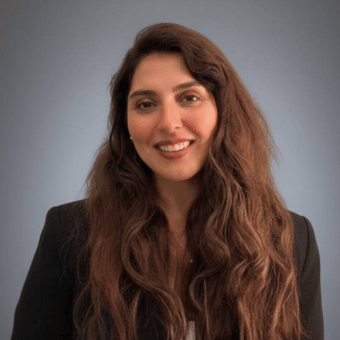
Katayoun Matloubi
Research Fellow, Hadassah–Brandeis Institute, Brandeis University & Non-Residential Research Fellow, USC Shoah Foundation
Katayoun Matloubi is a scholar of Holocaust and memory studies, Iranian Jewish history, and transnational Jewish and Middle East studies. She earned her PhD in French and Francophone Studies from the University of Connecticut, where she also completed a Graduate Certificate in Human Rights. Her work examines how Jewish memory, testimony, and historical violence move across languages, archives, borders, and political regimes, with particular attention to Iran, Europe, Israel/Palestine, and Iranian Jewish diaspora communities.
Her research brings Holocaust studies into sustained conversation with Middle East and Jewish studies. One strand of her work investigates the political and communal history of Iran’s Jewish population during the Pahlavi period and after the 1979 Revolution, including questions of integration, displacement, diaspora, and the changing place of Jewish memory in Iranian and Middle Eastern political culture. Her current article on Iran, Jews, Israel, and Palestine under the Pahlavi dynasty draws on declassified U.S. government records and the Foreign Relations of the United States series.
A second strand of Dr. Matloubi’s research focuses on testimony, translation, and the ethics of historicalt ransmission. Her work with Persian-language survivor and community testimony draws on the UCLA Iranian Jewish Collection and the Harvard Iranian Oral History Project, combining oral history analysis, archival research, and translation. Her current project, Machine Translation and Holocaust Memory Distortion, examines how neural machine-translation errors affect Persian and French Holocaust testimony, with implications for human rights documentation, genocide-prevention research, and the preservation of survivor memory. This project is being developed in conversation with the United States Holocaust Memorial Museum’s Sardari Project and was presented at the POLIN Museum of the History of Polish Jews in Warsaw.
Dr. Matloubi’s publications and current articles address formal absence, oblique testimony, perpetrator memory, Holocaust visual culture, Iranian Jewish history, and the politics of memory across European and Middle Eastern contexts. Her book manuscript, Representing the Holocaust in Novels and Films: Anna Langfus and Six Directors, develops a rhetoric of obliquity as a framework for understanding how literature and cinema register catastrophe through indirection, restraint, silence, and formal limitation.
Her public humanities work is grounded in museums, archives, and Holocaust education. She serves as an Educational Consultant for the Holocaust Museum and Educational Center in Philadelphia and has contributed historical research briefs and interpretive texts for an exhibition on antisemitism in Tehran at the Museum of Tolerance in Los Angeles. She is an alumna of the United States Holocaust Memorial Museum’s Curt C. and Else Silberman Faculty Seminar and Belfer National Conferences, an invited fellow of the 2026 Jacob and Yetta Gelman International Research Workshop, and a certified USC Shoah Foundation oralhistory interviewer.
Dr. Matloubi conducts research in Persian, Azeri, French, English, Ottoman Turkish, and Arabic.
| kmatloubi@brandeis.edu |